BRICS Summit 2026
Can the Global South’s Voice Reshape the World Order?
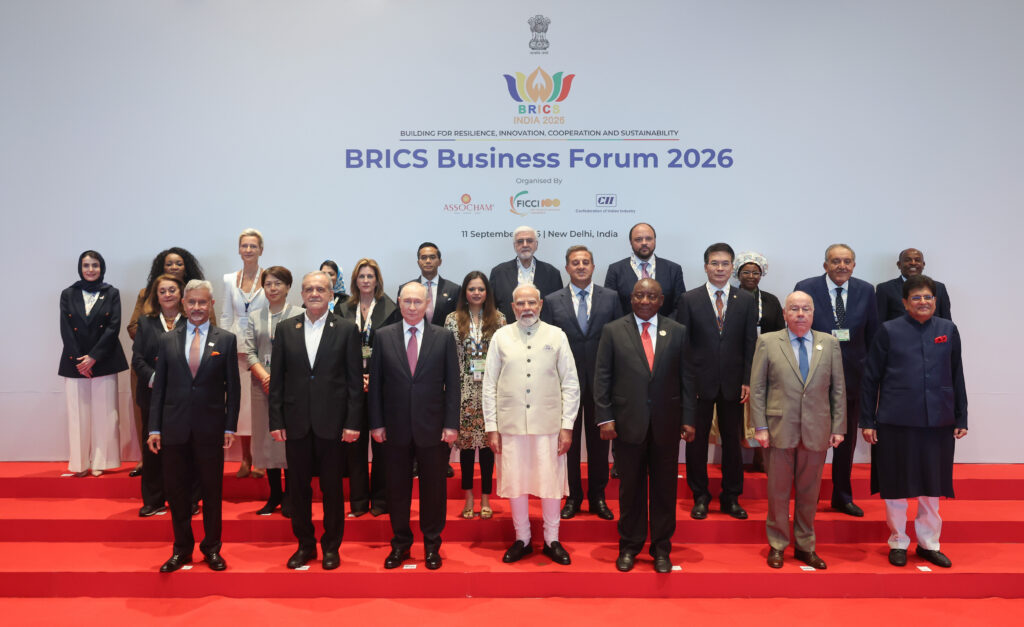
BRICS, representing nearly half of the world’s population, is no longer the small grouping of five emerging economies it once was. The 18th BRICS Summit, held in New Delhi on 12–13 September 2026, signalled that the Global South is seeking not just participation in global institutions, but a meaningful role in decision-making. Held under India’s chairship, the summit’s theme was “Building for Resilience, Innovation, Cooperation and Sustainability.”
The more important question, however, is this: can BRICS genuinely help reshape the world order, or does it remain caught between ambitious declarations and limited implementation?
## From a Five-Country Group to an 11-Member Platform
The name BRICS was originally formed from the initials of Brazil, Russia, India, China, and South Africa. By 2026, the grouping had expanded to 11 full members: Brazil, Russia, India, China, South Africa, Egypt, Ethiopia, Indonesia, Iran, Saudi Arabia, and the United Arab Emirates.
This expansion is not simply a story of rising membership numbers. It has strengthened BRICS’ geographical reach across Asia, Africa, Latin America, and West Asia. The presence of major energy producers, large-population economies, and rapidly growing markets gives the grouping greater significance in global affairs.
At the same time, it would be misleading to treat BRICS as a military alliance like NATO. It has neither a common military nor a mutual-defence treaty. It is a cooperation platform that operates through consensus, with each member participating while pursuing its own national interests.
## The Core Message of the New Delhi Summit
India assumed the BRICS chairship for the fourth time in 2026. The four words in the New Delhi summit theme—Resilience, Innovation, Cooperation, and Sustainability—offer a concise framework for addressing today’s global challenges.
Resilience means building collective capacity to withstand shocks such as pandemics, wars, climate disasters, and supply-chain disruptions.
Innovation focuses on expanding cooperation in AI, science, startups, digital public infrastructure, and emerging technologies.
Cooperation involves developing practical partnerships in trade, health, food, energy, and finance.
Sustainability means pursuing development without placing unsustainable pressure on the environment, resources, and future generations.
The New Delhi Declaration emphasised sovereign equality, inclusiveness, collaboration, and consensus. This language reflects BRICS’ effort to present itself not as a bloc led by a single power, but as a diverse platform for cooperation among sovereign states.
## Why Does BRICS Matter to the Global South?
Many global institutions created or shaped after the Second World War—such as the IMF, World Bank, and UN Security Council—do not fully reflect today’s economic and demographic realities. Asia, Africa, and Latin America have increased their contribution to global production, trade, and population, but their influence in key decision-making institutions has not grown at the same pace.
BRICS raises questions about this imbalance. Its central argument is that global governance should become more representative, democratic, and multipolar. This does not necessarily mean opposition to the West. Rather, it reflects a demand for an international system in which the priorities of developing countries—development finance, food security, energy access, healthcare, and technological access—receive greater attention.
## NDB and CRA: Institutional Strength Beyond Declarations
BRICS should not be assessed only through summit photographs and diplomatic statements. Two important financial mechanisms give the grouping a more practical institutional foundation.
The New Development Bank (NDB) mobilises finance for infrastructure and sustainable-development projects. Its headquarters are in Shanghai. For emerging and developing economies, it provides an additional channel for development finance.
The Contingent Reserve Arrangement (CRA) is a $100 billion liquidity-support framework. Its purpose is to provide a financial safety net to members facing external payment pressures or financial stress.
These institutions are not yet comparable in scale with the IMF or World Bank. Even so, they demonstrate that BRICS is not solely a forum for discussion; it has also created alternative institutional mechanisms.
## Does BRICS Have Its Own Currency?
No. As of 2026, there is no common BRICS currency in operation.
BRICS countries have been discussing stronger use of local currencies in trade, cross-border payment systems, and settlement mechanisms. Such efforts could reduce transaction costs, increase flexibility in payments, and lower risks associated with excessive dependence on any single currency. But local-currency trade is not the same thing as a common currency.
A shared currency would require coordinated monetary policy, a central-bank framework, an exchange-rate mechanism, and much deeper macroeconomic coordination. Given the diversity of BRICS economies and their strategic priorities, such an arrangement remains difficult in the near term.
## Opportunities for India
For India, BRICS creates diplomatic, economic, and strategic opportunities at the same time.
India can share its experience in digital public infrastructure, affordable healthcare, disaster management, and development with other countries. This can strengthen its role as a bridge between the developed and developing worlds.
The 2026 ministerial process placed emphasis on MSME trade finance, global value chains, and digitally delivered services. For India, these areas could create new opportunities for services exports, startups, and small businesses.
BRICS also includes both major energy producers and major energy consumers, creating scope for cooperation on energy security, critical minerals, clean energy, AI, and digital systems.
BRICS gives India a single forum for dialogue with important countries from China, Russia, West Asia, Africa, and Latin America. This can be useful at a time when the international system appears to be evolving around multiple and competing centres of power.
## The Real Challenge: Building Consensus Among Diverse Interests
BRICS’ greatest strength is its diversity—and that is also one of its biggest challenges. Its members differ in political systems, economic models, security concerns, and foreign-policy priorities.
The complexity of India–China relations, rivalries in West Asia, and tensions between Russia and the West can make common positions difficult to build on some issues.
A consensus-based system gives smaller countries a voice, but it can also slow decision-making. Unless declarations are translated into measurable projects, easier trade access, effective payment connectivity, health cooperation, and development finance, a larger membership will not automatically produce greater influence.
## Conclusion
BRICS should neither be treated as a ready-made replacement for the Western-led international order nor dismissed as merely symbolic. Its practical strengths lie in its large demographic and economic weight, its shared platform for the Global South, and institutions such as the NDB.
Its limitations are equally clear: deep differences among members, slow consensus-based processes, and the challenge of turning declarations into implementation.
The New Delhi Summit has helped clarify the direction: more representative global governance, stronger development finance, greater technological cooperation, and more resilient supply chains. The real test now is how quickly BRICS can turn broad language into concrete outcomes.
For India, success will not be measured only by hosting the summit. It will also depend on building trust among diverse countries and helping produce outcomes that can reach ordinary citizens, farmers, students, startups, and small businesses. If BRICS can do that, it could become not an opposing bloc to the global order, but an influential platform for making that order more balanced.
“The Next Hope of Subcontinent”